AI Consulting: The Handoff Is Where Projects Die

What AI Consulting Is, and What It Is Not
Say you run a company and everyone keeps telling you to "get into AI." Where do you start? Who do you ask? What does it cost? And a year from now, what will you actually have?
This article is for those questions. We keep the jargon out, and where a technical word is unavoidable we explain it on the spot. By the end you will know what to ask when a consultant sits down across from you.
We are Hitit Medya, four software engineers. We work on both sides of this business, the explaining and the building, and we have seen what the gap between them costs.

THE SHORT VERSION
Most AI projects close without making anyone any money. The reason is rarely the technology. Companies buy a report when what they needed was a working system, and those are very different purchases. This article shows you the real numbers first, then gives you four questions to ask any AI consultant. After that we explain the thing most companies overlook: your website is the right place to start. And finally, to show we can actually do this work, we walk through the hardest system we run, one that makes dozens of cameras in a building talk to each other.
Start With These Numbers
Spending money on AI and making money from AI are not the same activity. Three pieces of research show the gap. Under each one, what it means for you.
30%
AI projects shelved after the trial stage. The stated reasons are messy data, costs running out of control, and unclear benefit.
Gartner press release, July 2024
95%
AI trials that end without any measurable effect on profit, against 30 to 40 billion dollars spent in the same period.
MIT Project NANDA, 2025
67%
Success rate when your own team and an outside specialist build together. Going it alone drops that to 22 percent.
MIT Project NANDA, 2025
Look again at the reasons behind the first number: messy data, runaway cost, unclear benefit. Not one of them is a technology problem. All three mean the same thing: nobody thought it through before starting.
The last number is the encouraging one. Getting help works. Companies that go it alone fail three times as often. The help just has to be the right kind.
The Most Common Mistake: Buying a Report, Expecting a System
Two different things are sold under the name AI consulting, and because they share a name they get confused.
What do you end up holding?
A thick slide deck, a twelve month roadmap, and a proposal for the next phase. No software.
The same analysis, but it ends with software that runs. And the keys to it are handed to you.
Who does the data work?
Your data gets a maturity score and a list of gaps. Fixing them is your problem.
We collect it, clean it and bring it together in one place. Without that step, AI cannot do anything at all.
How is success measured?
People trained, licenses activated, phases completed.
One business number, measured before anything is built. How long a quote takes to prepare, say. Then measured again the same way.
What is left when it ends?
A document. Nobody knows how to run the system, because there is no system.
The software is yours, the servers are in your account, and someone on your team has learned to run it.
Both have their place. Convincing a board sometimes genuinely requires a good strategy document. Just buy it knowingly. To say you have moved into AI, something has to be running.
Four Questions You Can Ask Any Consultant
You do not need to be technical. These four reveal which kind of firm you are talking to in the first meeting. Ask us too, we will answer them gladly.
- 01
"Will you look at my data before quoting?"
Anyone who gives you a price and a timeline without opening your data is guessing. The right answer sounds like this: "Give us read access to one system, let us look, then we will talk." Projects overrun because the data was not where everyone assumed, almost never because the AI was hard.
- 02
"What does this cost me if I grow ten times?"
AI cost is not a flat fee. It grows with use, so the more successful you are the more you pay. The right answer is a calculation that shows you which line grows fastest. Skip this question and you will learn the answer in month four.
- 03
"Who runs this after you leave?"
If the answer is "we will look after it, monthly fee attached," you are being sold a subscription rather than a system. The right answer includes a named person on your side, a plain-language runbook, and access to the software itself from week one.
- 04
"Which number are we improving, and what is it today?"
If nobody measured the starting point, nobody can argue about the finish. That is a very comfortable position for one side of the table. Pick one number and write it down before work begins.
If this way of choosing is useful, the same thinking applied to a different decision is in our guide on how to choose a web design agency.
The Surprising Answer: Start With Your Website
AI needs one thing before it needs anything else: information that sits together, in order. Give it scattered information and it behaves exactly like a new hire on day one. It knows nothing.
In most companies the information lives in three places. Customer records in one program, internal documents in a shared folder, sales figures somewhere else. No single piece of software sees all three.
Your website is the one place where all three of your audiences already meet. Built properly, it stops being a shop window and becomes the center of the company.
- For customers and members. Where they find what you offer, see their own record, raise a request and follow it. An assistant placed here answers from your information, not from the open internet. It knows what is in stock, where the order is, what clause 7 of the contract says.
- For your staff. The company memory. Procedures, price lists, technical documents, old proposals. Everything a new employee currently gets by asking whoever has been there longest. Put it behind one search box and that knowledge stops depending on individuals.
- For you. The dashboard. Which service draws interest, where requests get stuck, which page turns into a customer. Instead of waiting for the month-end report, seeing the evidence for a decision while you make it.
Splitting those three across separate systems is the most expensive habit in mid-sized business, because every integration you buy afterward is really an attempt to undo it. Building the site as a platform from the start costs less than building three systems and a bridge between them.
That is why we begin here. Our Next.js web work and headless content setups turn a site from a publishing tool into a platform that gathers information. The AI layer then sits on top easily, because at last there is something tidy for it to look at.
The Cloud Question Is Not "Should We Move"
First, plainly: the cloud means your software runs on a rented server instead of a machine in your office. Think of it like electricity. Rather than buying a generator, you pay for what you draw from the grid.
In meetings the question is always "should we move to the cloud." That is the wrong question. The right one is which job belongs where.
Cloud pays off when your work fluctuates. Traffic that multiplies during a campaign, a heavy calculation that runs twice a month, a seasonal peak lasting six weeks. Buying a permanently running server for those means paying for nothing eleven months a year.
But it quietly drains money in three places, and they are the same three in every company.
- Getting your data back out is expensive. Putting files in is cheap. Downloading them is charged. In companies that move large files this is reliably the line that surprises the finance team. When we built our own map system we specifically chose a provider with no download charge, because we did the math beforehand rather than discovering it later.
- Idle power is billed too. The powerful machines rented for AI charge for the hours they exist, not the hours they work. Paying twenty-four hours for a job that runs two is enough on its own to wipe out a project's return.
- The layers multiply. Each service looks reasonable on its own. The total does not. A company that cannot match a bill line to a business process will spend a year decoding its own invoice.
Our cloud work is an arithmetic exercise before it is a technology choice. How often each job runs, how much data it moves, how the peaks fall. The answer is usually a mix: fluctuating work in the cloud, steady and predictable work on fixed capacity. That is what cloud solutions means on our side, and what you get is a built system, not a recommendation.
But Do You Actually Know How to Do This?
A fair question. The quickest way to judge how deep an agency really goes on AI is to ask for the hardest thing it has built. Here is ours.
Picture a shopping center with dozens of security cameras. Someone walks past camera one, disappears, and shows up a while later on camera five. A human brain settles this instantly: same person. For a computer it is genuinely hard. The angle has changed, the lighting has changed, and for a stretch the person was visible to no camera at all.
We built the system that solves this, and it runs in our API network. Here is how it works, in six steps.
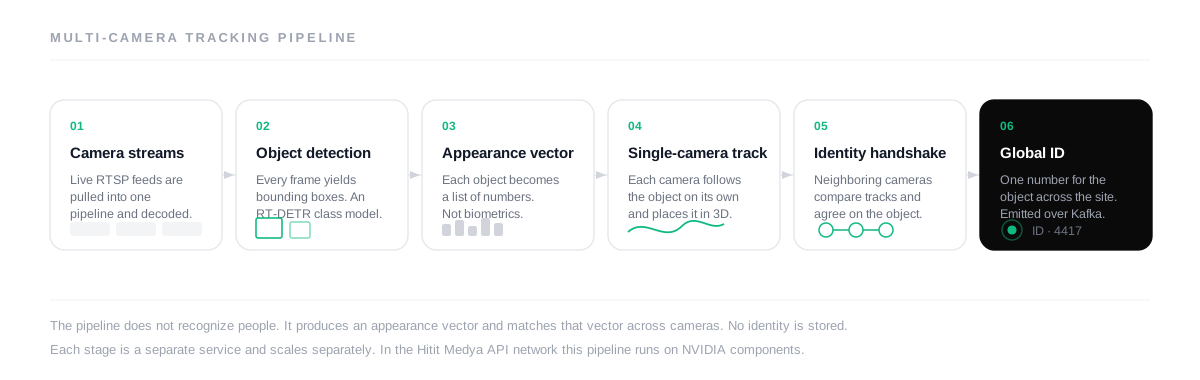
The key point is this: no single AI can do this job. Several run at once. One finds the objects in the picture. Another turns each object into a set of numbers, so two sightings can be compared mathematically. A third combines those numbers with time and location to make the call: yes, same object.
The NVIDIA components it is built on
DeepStream
The base layer that opens dozens of camera feeds at once and distributes them to the AI models.
Metropolis microservices
Structure that splits the system into small parts instead of one large program. Each part grows only as much as it needs to.
Re-identification models
Ready-made models that turn an object's appearance into a set of numbers. Matching across cameras happens with those numbers.
NVIDIA, DeepStream and Metropolis are trademarks of NVIDIA Corporation, referenced here solely to describe the technologies our infrastructure is built on. This does not imply partnership or endorsement.
Let us be plain about privacy, since it is the first thing anyone asks about cameras. The system does not recognize anyone. It stores no identity and saves no faces. The only question it answers is whether the object on camera three is the same as the object on camera five.
Now the real question: if your business has no cameras, why should you care? Because a team that can build this can comfortably build the simpler thing you need. The difficulty is always in the same place. Running several AI models at once, keeping them fast, keeping the cost under control. Having done it once makes everything after it easier.
How Working With Us Goes
Four steps. At the end of each one you hold something real.
- 01
We pick one job
We do not try to transform the whole company. We choose one job where improvement will be obvious to you. What you hold at the end: a one-page agreement naming the number we are moving and where it stands today.
- 02
We gather the data
Whatever feeds that job gets collected, cleaned and moved into one place. What you hold at the end: a working data setup. This is usually the longest step, and we say so at the start rather than in week six.
- 03
We build small, then measure
Which AI to use is decided here, not at the beginning. The system runs with real users and real data. What you hold at the end: software live in production, and the new value of the number from step one.
- 04
We hand over the keys
The software moves to your repository, the servers to your account. Someone in your company learns to run it and what to do when it breaks. What you hold at the end: a system that stands up without us.
We do this for one job at a time. The second goes much faster than the first, because the data setup and the infrastructure already exist. The most common mistake we see is a first project that aims at ten jobs and finishes none.
When You Should Not Call Us
Worth saying plainly, because knowing what we are not is the fastest way to understand what we are.
- You want to transform the entire company, every department at once. Multi-country, multi-unit transformation programs are a real discipline and large consultancies do them properly. We are four engineers. That is the right size for building a system and the wrong size for running an organizational program.
- You want your own AI trained from scratch. Almost no company needs this, and the ones that genuinely do have research teams. If someone offers it to you, ask what retraining it costs.
- You only want the presentation. Sometimes convincing a board really does require a good strategy document. That is a legitimate need, just not our work. We would rather tell you that than produce a worse version of it.
Where should AI start in your company?
Let's work out which job improves and whether your data is ready for it. What you get at the end is a running system, not a presentation.
In the first conversation we will also tell you which project not to do.
Frequently Asked Questions
01What does AI consulting actually include?
Three jobs. First, finding where AI will genuinely pay off in your company. Second, preparing the data and infrastructure that requires. Third, building the system and handing it to you. Most of the market stops after the first and calls the roadmap a delivery. We treat all three as one engagement, because doing only the first changes nothing inside the company.
02Is a small company too early for AI?
No, but the target has to be chosen well. Training your own AI from scratch is unnecessary at that size. On the other hand an assistant that answers from your own documents, a setup that speeds up preparing quotes, or automatic sorting of incoming requests all pay back quickly at modest scale. What decides it is not how big you are. It is whether your information sits in one place or seven.
03You are a web design studio. How do you do AI work?
Hitit Medya is four software engineers. Web design is the front of the shop, because it is what companies need most often and what we do best. Behind it the work is software engineering: data setups, cloud architecture, real-time vision systems, our own map infrastructure. AI is not a feature we bolt onto a site. It is the same engineering pointed at a different problem.
04Will our data leave our environment?
You make that decision at the start. Some problems are solved far more cheaply with an outside provider's AI. Others involve data that must never leave the company. We put the cost and the constraint of both options in writing. Either way, servers are set up in your account and the software lives in your repository.
05Why talk about the camera system? What good is it to us?
Because claiming AI expertise is easy and building systems is not. That camera system requires several AI models running at once without losing speed. It is used in retail to follow customer flow, in warehouses to track shipments, in manufacturing to measure movement on the line. But we describe it as evidence rather than as a product: your simpler project contains the same difficulty in smaller form.
06How long does it take and what does it cost?
Because we keep the scope deliberately narrow, a first working system usually arrives in weeks rather than quarters. What sets the timeline is almost never the AI. It is the state of your data. That is also why we will not quote a duration or a price before we have looked at it.
References
The original press release, including the stated reasons for abandonment.
Source of the 95 percent figure and of why blended teams outperform going it alone.
Reference architecture for multi-camera tracking: detection, conversion to numbers, identity matching and a single shared ID.
The toolkit the multi-camera video analysis is built on.